
Saving 15,000 Metric Tons of Water: How Smart Pump Controllers Combat India’s Groundwater Crisis
Discover how IoT-based smart pump controllers are saving 15,000 metric tons of water annually, tackling India’s groundwater depletion while reducing electricity costs for farmers.
The Rising Threat: Groundwater Depletion in India (2026)
As of early 2026, India remains the world’s largest consumer of groundwater. With the Ministry of Jal Shakti reporting that nearly 70% of districts face critical depletion levels, the agricultural sector—which consumes 89% of this resource—is under intense pressure. Traditional irrigation methods are no longer sustainable.
However, a technological shift is happening at the borehole. Modern smart pump controllers, like the Varun S3, are moving the needle from “Flood Irrigation” to “Precision Agriculture.”
By the Numbers: How We Save 15,000 Metric Tons
To understand the scale of the “Small Device” revolution, we must look at the Energy-Water Nexus through a statistical lens:
- The Leakage Problem: A standard 5-HP pump discharges roughly 30,000 liters per hour. On average, manual operation leads to 45 minutes of “overflow” daily due to delayed shut-offs.
- Annual Wastage: That’s 8.2 million liters (8,200 MT) of water wasted per pump, per year.
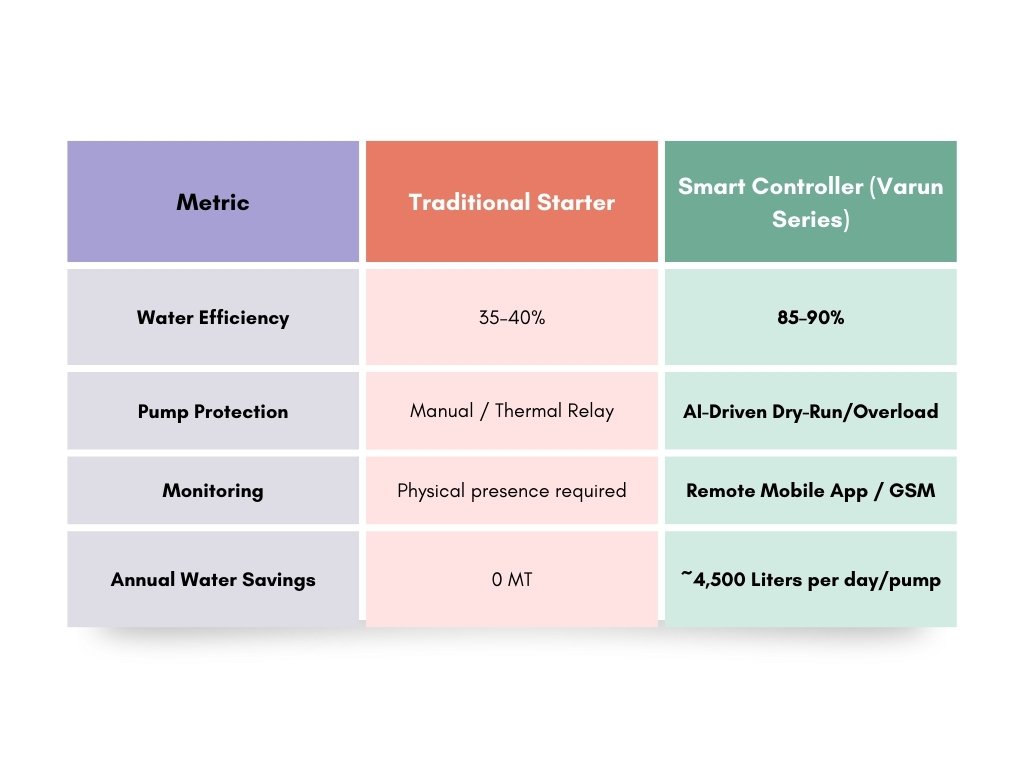
- The 15,000 MT Impact: By deploying smart controllers across a small cluster of just 2,000 farms, the automated “Dry-Run” and “Overload” cut-offs prevent over 15,000 Metric Tons of unnecessary extraction annually.
Technical Edge: IoT and RF Mesh Technology
How does a small device achieve such massive savings? It comes down to Edge Intelligence:
1. Dry-Run Protection & Current Sensing
Using high-precision sensors, the controller monitors the electrical current. When the water level drops (Dry-Run), the device detects the change in motor load and terminates the cycle in milliseconds. This prevents “air-pumping,” which wastes energy and depletes low-yield aquifers.
2. Smart Scheduling & Evaporation Control
Through the Varun Mobile App, farmers can schedule irrigation for pre-dawn hours. Scientific data shows that night-time irrigation reduces evaporation loss by 12–15%, ensuring every drop reaches the root zone.
3. Connectivity Without Internet (RF Mesh)
In many parts of rural Bharat, 4G/5G is spotty. The latest controllers use RF (Radio Frequency) Mesh technology, allowing farmers to control pumps from up to 3km away without needing an active data connection.
Aligning with Government Initiatives: PM-KUSUM & AgriStack
The shift toward smart irrigation isn’t just a choice; it’s being incentivized. The PM-KUSUM Scheme and the Digital Agriculture Mission (AgriStack) are prioritizing “Per Drop More Crop.”
By integrating smart controllers with solar pumps, farmers can achieve 100% energy independence while contributing to the national goal of restoring groundwater levels under the Atal Bhujal Yojana.
Are you ready to modernize your farm and save water? Explore the Varun Smart Controller Range →
