
Why Smart Water Management Matters in 2025: Scheduling Drip Irrigation for Sustainable Farming
Imagine being a farmer in rural Bharat, waking up at dawn to manually switch on your drip irrigation system, only to find the borewell running dry or the pump burning energy unnecessarily. With water scarcity hitting states like Maharashtra, Rajasthan, and Tamil Nadu hard, and electricity costs soaring, every drop and watt matters. Enter smart water management, using tools like automatic water pump controllers to schedule and automate drip irrigation, saving water, energy, and time for Bharat’s rural farmers.
In 2025, smart drip irrigation automation in India is transforming farming, especially for smallholder farmers battling erratic monsoons and depleting groundwater. This guide explores how scheduling and automation can revolutionize your drip irrigation system, with actionable steps to implement them using smart water pump controllers like Varun. Let’s dive in!
Benefits of Automation in Drip Irrigation
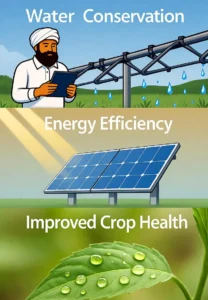
Automation takes the guesswork out of irrigation, ensuring crops get the right amount of water at the right time. By using a smart water pump controller, farmers can reduce water waste by up to 40% and energy costs by 20-30%, as seen in 20,000+ Dyulabs’ user data across India’s diverse geography and climate. It also saves time, letting you focus on sowing, harvesting, or market visits instead of trekking to the borewell.
Key advantages include:
- Water Conservation: Precise delivery prevents over-irrigation, critical in water-stressed regions. (Save 300+ liter of water)
- Energy Efficiency: Automated shutoffs and schedules avoid unnecessary pump operation. (Save 40% electricity costs)
- Crop Health: Consistent watering boosts yields by 15-25% for crops like sugarcane or cotton.
How Scheduling Saves Water and Energy

Scheduling with a water pump controller aligns irrigation with crop needs and weather patterns. For example, drip irrigation for tomatoes requires short, frequent cycles, while wheat needs less frequent but deeper watering. All Varun models allow scheduling directly on it or remotely via app, even in low-connectivity areas, saving 15,740 metric tons of water annually across Dyulabs’ user base. By running pumps during off-peak tariff hours, you can also cut electricity bills significantly.
Integrating Varun Controllers for Smart Irrigation
Varun’s lineup S1 (3km RF remote), S2 (SIM-based), and S3 (hybrid RF and GSM) is designed by keeping the challenges faced by Indian farmers. These automatic water pump controllers work without internet, using RF mesh for reliable control in remote fields. Features like dry run protection prevent motor damage, while solar compatibility supports eco-friendly farming under schemes like PM-KUSUM. Farmers in Andhra Pradesh report saving 5.3 km of daily commuting by controlling pumps remotely.
Why Varun Stands Out:
- No-Internet Operation: RF mesh and app control work in low-signal areas.
- Ease of Use: DIY installation in 3 minutes, with a 2-year warranty.
- Versatility: Supports single and three-phase motors up to 40HP.
Future Trends in Smart Irrigation for 2025
By 2025, smart irrigation is set to grow with AI-driven scheduling and IoT integration. Trends include:
- Solar-Powered Systems: Energy-saving irrigation controllers will increasingly pair with solar panels, reducing grid dependency.
- Data-Driven Farming: Apps will predict water needs using weather and soil data, enhancing efficiency.
- Government Support: Schemes like Atal Bhujal Yojana will subsidize smart controllers, making them affordable for small farmers.
Varun’s S3, with its mobile app and hybrid control, is already ahead, offering features like voltage monitoring and auto-restart for seamless operation.
Step-by-Step Guide to Implement Smart Drip Irrigation
Ready to automate your drip irrigation? Here’s how to get started with a smart water pump controller like Varun:
- Step 1: Assess Your Setup Check your drip system and borewell pump (single or three-phase, up to 40HP). Ensure compatibility with Varun S2 or S3 for advanced scheduling.
- Step 2: Install Varun Controller Connect Varun to your DOL starter (follow Dyulabs’ YouTube guide: Single Phase Installation). Wire the CT sensor and relay, securing with basic tools – no electrician needed.
- Step 3: Set Schedules Use the Varun app or you can do on the device itself to schedule irrigation, e.g., 30-minute cycles twice daily for vegetables. Adjust based on crop type and local weather apps.
- Step 4: Enable Protections Activate dry run and overload protection via the app and stop pumps during low supply, saving energy.
- Step 5: Monitor and Optimize Track water and energy usage via notification logs on app. Shift irrigation to off-peak hours and integrate solar panels for maximum savings.
- Step 6: Maintain and Scale Check logs monthly for faults. Contact Dyulabs support (+91 97202 97101) for troubleshooting. Expand to more fields as savings grow.
Conclusion: Farm Smarter with Varun in 2025
Smart water management through scheduling and automation is a lifeline for Indian farmers facing water scarcity and high energy costs. With Varun water pump controllers, you can save water, cut bills, and boost yields while farming sustainably. Whether you’re in a remote village or a semi-urban farm, Varun’s no-internet control, dry run protection, and solar-ready design make it a perfect fit.
Take the first step toward smarter irrigation. Visit dyulabs.com to explore Varun S1, S2, and S3, and get up to 40% off with free shipping. Watch our YouTube tutorials for easy setup guides in all regional languages – Hindi, Kannada, etc. let’s grow a greener India together!
