Net Metering vs. Gross Metering in India (2026): State-Wise Comparison & Best Policies
When you decide to go solar in 2026, you aren’t just buying panels; you are choosing a billing relationship with your electricity provider (DISCOM). This relationship is defined by two systems: Net Metering and Gross Metering.
Think of Net Metering as a “Savings Account” and Gross Metering as a “Side Business.” Here is the breakdown that makes sense for everyone.
1. The Core Difference: How They Work
Net Metering (The “Savings Account”)
Your home uses the solar power it needs first. Any leftover electricity is “pushed” into the grid. At the end of the month, the electricity board only bills you for the Net Difference.
- Visual: Your meter literally runs backward when you’re exporting.
- Benefit: You save on the “Retail Rate” (e.g., ₹8 per unit). This is the fastest way to get your investment back.
Gross Metering (The “Side Business”)
You don’t use your solar power directly. 100% of the energy your panels make is sold to the grid at a fixed Feed-in Tariff (FiT). You continue to buy all your home’s power at the normal rate.
- Visual: You have two separate meters—one for what you sell, one for what you buy.
- Benefit: It’s great if you have a massive roof but very low electricity needs.
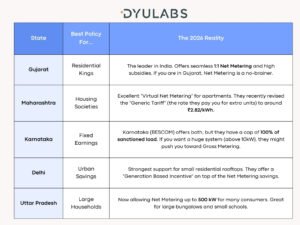
2. 5 State-Wise Comparison (2026 Policy Landscape)
As of 2026, the PM Surya Ghar: Muft Bijli Yojana has unified many rules, but states still have their own “flavors.” Here is where you get the most bang for your buck:
3. Which One Should You Choose?
Choose Net Metering if:
- You want to reduce your electricity bill to Zero.
- Your residential load is between 1 kW and 10 kW.
- Your state allows a 1:1 credit (like Gujarat or Delhi).
Choose Gross Metering if:
- You are an Industrial or Commercial entity with a massive roof but low daytime power use.
- Your state (like some parts of Tamil Nadu or Kerala) has restricted Net Metering for high-capacity systems.
- You want a fixed, guaranteed check from the DISCOM every month regardless of your own usage.
4. Technical “Insider” Tip for 2026
In 2026, many DISCOMs are moving toward Net Billing (a hybrid). In this model, the power you use is free, but the “extra” you sell back is credited at a lower “wholesale” rate rather than the retail rate.
The Strategy: Always size your solar plant to cover 80-90% of your actual consumption. Over-sizing to “make money” via Gross Metering rarely pays off as well as saving money via Net Metering.
