
Read This Before Purchasing Solar!
Switching to solar is one of the smartest moves you can make in 2026—both for your wallet and the planet. But if you’ve started researching, you’ve likely realized it’s not as simple as “putting panels on a roof.” Between grid-ties, hybrids, and monocrystalline cells, the confusion can get overwhelming fast.
This guide breaks down the different types of solar systems and, more importantly, tells you exactly who should be using them.
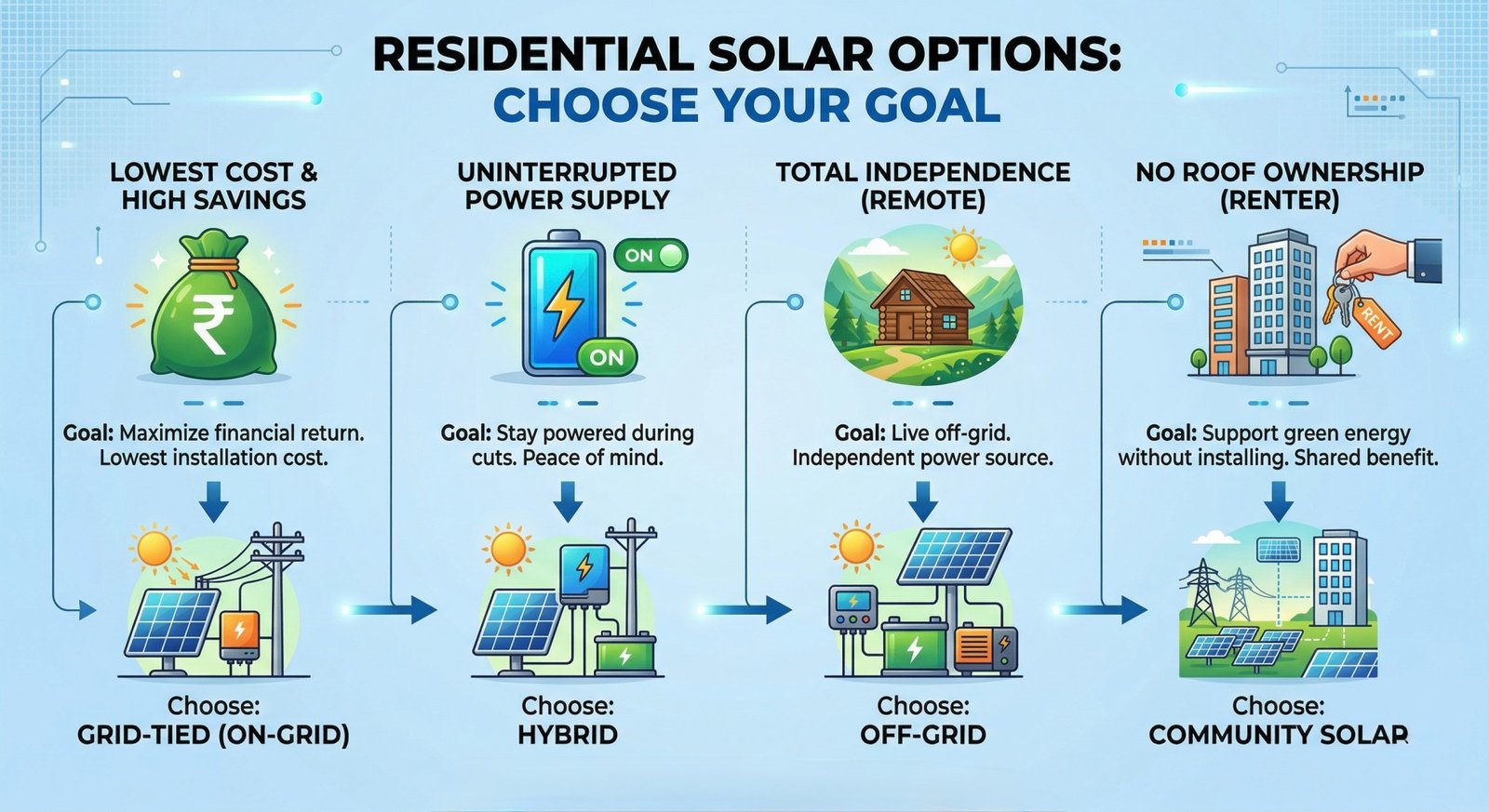
1. The Grid-Tied System: The “Savings King”
This is the most popular setup for residential homes. Your panels are connected to the main municipal power grid.
- How it works: During the day, your panels power your home. Any extra energy is sent back to the grid, and your meter “spins backward” (Net Metering). At night, you pull power from the grid like normal power.
- Best For: Urban and Suburban Homeowners.
- Why choose it: It has the lowest upfront cost because you don’t need to buy expensive batteries. It offers the fastest Return on Investment (ROI), often paying for itself in 3–5 years which is very fast.
2. The Off-Grid System: The “Freedom Fighter”
This system is completely independent. You are your own power company.
- How it works: Your panels charge a massive battery bank during the day. You rely entirely on those batteries to run your appliances at night or during cloudy weather.
- Best For: Remote Cabins, Farmhouses, or Rural Areas.
- Why choose it: If the main power lines don’t reach your property—or if it costs a fortune to get them there—off-grid is your only solution. It requires a bigger budget and regular maintenance, but the independence is unmatched.
3. The Hybrid System: The “Security Guard”
The ultimate modern setup. It’s a grid-tied system that also includes a battery backup.
- How it works: You stay connected to the grid to earn credits, but you also keep a battery (like a Tesla Powerwall) charged. If the grid goes down, your home stays powered without a flicker.
- Best For: Areas with Frequent Power Cuts.
- Why choose it: It’s the “best of both worlds.” You get the financial savings of the grid plus the peace of mind that your Wi-Fi, fridge, and lights will never turn off during a blackout.
4. Community Solar: The “Renter’s Loophole”
Don’t own a roof? No problem.
- How it works: You “subscribe” to a large solar farm located elsewhere. The energy they produce is credited directly to your utility bill.
- Best For: Renters, Apartment Dwellers, or Shaded Homes.
- Why choose it: There is zero installation and zero maintenance. It’s the easiest way to lower your carbon footprint without touching a single tool.
Summary: Which one are you?
If you want… |
You should choose… |
|---|---|
| To save the most money | Grid-Tied |
| To never face a blackout | Hybrid |
| To live in the middle of nowhere | Off-Grid |
| Solar, but you rent your home | Community Solar |
A Note on Technology
When choosing your panels, you’ll hear about Monocrystalline (the black ones) and Polycrystalline (the blue ones).
- Go Mono if you have a small roof; they are more efficient.
- Go Poly if you have a massive amount of space and want to save a bit more on the initial hardware.
Ready to make the switch? The best first step is to check your last three electricity bills to see your average “units” (kWh) consumed. This will help a professional size your system perfectly!
